NEUBIE E-Stim
The muscle has not gone anywhere. When pain has been turning it down for months, telling it to work harder is not what brings it back.
What is NEUBIE e-stim?
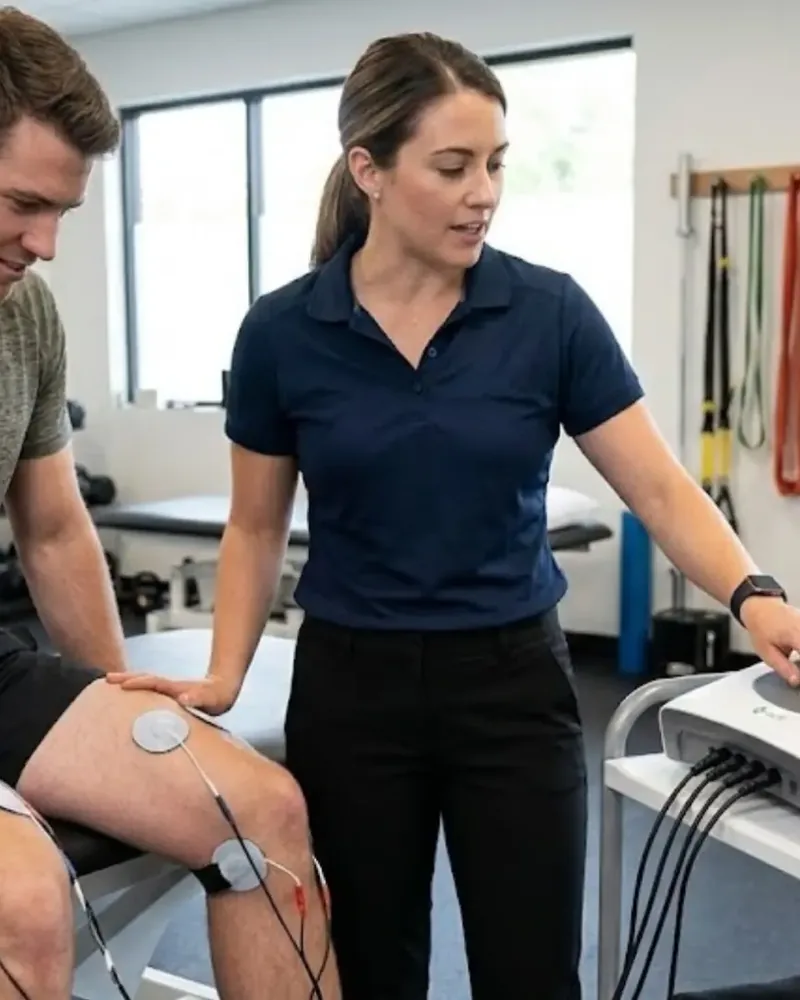
The NEUBIE is an electrical stimulation device we use inside a treatment session, not a treatment on its own. Pads go on the skin over the area we are working, and the unit sends a direct current through them. That is the detail worth understanding, because most stimulation people have met before, including the unit sitting in a drawer at home, runs on alternating current and is mainly there to make pain quieter for a while. Direct current gets used differently here. It runs while you are moving, so a muscle that pain has been inhibiting receives a strong outside signal to contract at the same moment you are asking it to. Intensity, frequency and duration are all set for you and adjusted as the session goes, and you hold the say on the level. The device is non-invasive and FDA-cleared.
What it is genuinely useful for is the gap between what a muscle can do and what your nervous system is currently allowing it to do. After knee surgery, the quadriceps often will not switch on properly for weeks even though the muscle itself is intact. Pain and swelling turned the volume down, and every exercise stacked on top of that gets performed by everything except the muscle you were trying to train. Stimulation during movement helps re-establish the contraction so the exercise lands where it was aimed. It reduces pain for a lot of people too, and it will not make pain vanish for good. Anybody promising you that a machine does that is selling you something. This is one tool inside a forty minute, one on one session in Swansea or Providence, used alongside manual therapy and the exercise plan that does most of the actual work.
Who it's for.
Stimulation earns its place when the problem is activation: the muscle is there, and something is standing between your intent and the contraction. Three situations where that is usually the case.
A post surgical muscle that will not switch on
After an ACL reconstruction or a rotator cuff repair, the repair holds but the muscle around it stays quiet. Stimulation during your exercises gives us a way to load that muscle properly now instead of waiting months for it to volunteer.
Long standing pain that limits every exercise
Back, neck, knee or shoulder pain that has been around long enough that you brace before you move. Guarding caps how much useful work you can do, and stimulation can open a window where the exercise is finally worth the visit.
A neurological condition affecting activation
For people living with the effects of a stroke, multiple sclerosis or Parkinson's, this is used as an adjunct to physical therapy and never as a treatment for the condition itself. The target is the link between intent and contraction.
What to expect in a session.
You stay in charge of the intensity from start to finish. Nothing gets turned up without you saying so, and stimulation is only ever one part of the visit rather than the visit itself.
A before, so there is something to compare
Your therapist confirms exactly what we are trying to wake up, then tests it without stimulation first. That gives us a starting point, which matters because activation changes are easy to feel and easy to imagine.
Pads on, level set by you
Pads are placed over the region we are working, then the level comes up gradually and stops where you tell us to stop. Strong and tolerable is the target, and nothing about this session requires you to push through pain to be useful.
You move while it runs
This is the part that separates it from lying under a machine. You contract, step, press or lift while the current is running, so the signal arrives at the same instant your own effort does. Your reps are still doing the learning.
Off, then retest
We shut it down and retest the same thing from step one so you can judge whether activation actually improved. Then it folds back into your regular plan, including the home exercises that carry the progress between visits.
Before any stimulation is used, your therapist reviews your medical history with you and confirms that electrical stimulation is an appropriate choice for your situation. If it is not the right tool for you, we say so and we use something else. It is never the whole plan, and you are never locked into it.
Specht PT took me from day 3 of a total knee replacement to graduation by listening to me, hands-on massage and manipulation and re-educating me on exercising and using my new knee.
Where to go next.
Physical Therapy
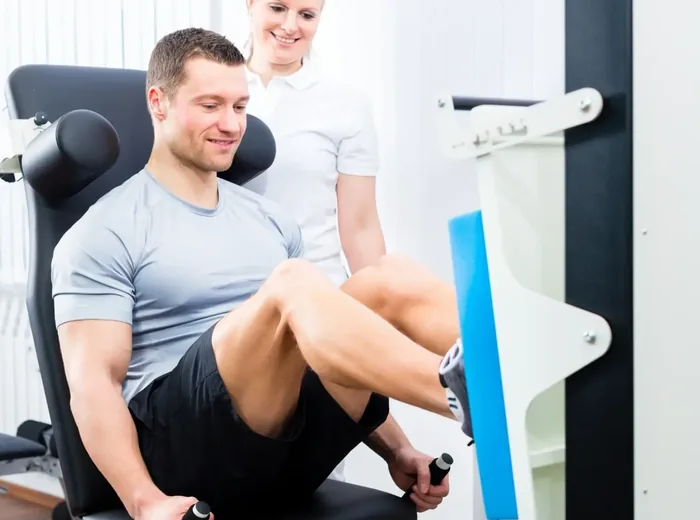
Forty minutes, one on one, with a licensed physical therapist who knows your case.
Chronic Pain
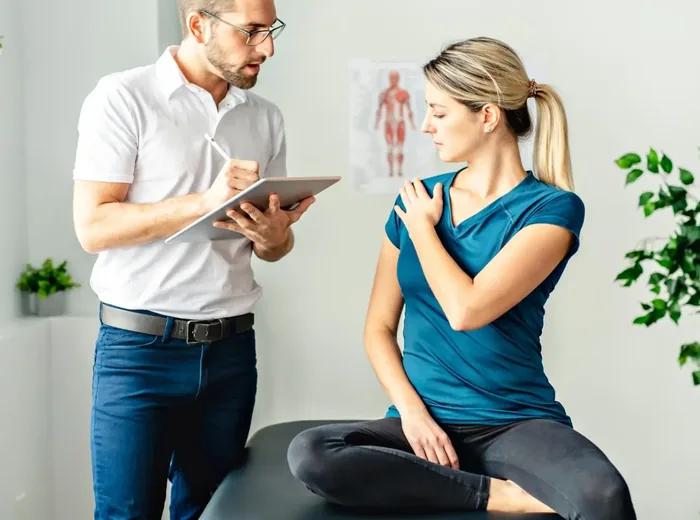
Pain that outlasted the injury. We change how the system responds, not just the tissue.

Nerve Pain
Tingling, burning, electric shocks down a limb. We find where the nerve is being crowded.
Ready when you are.
Fri: 7:00am - 3:40pm