Back Pain & Sciatica Treatment in Swansea
You have rested it, stretched it, and waited it out, and it still decides how long you can sit, stand, and sleep. That is not a discipline problem. It usually means nobody has looked in the place the pain is actually coming from.
What causes back pain & sciatica?
Your spine is a system: discs, facet joints, nerves, and the muscles that share load between them. When one part stops carrying its share, another absorbs the difference, and the place that hurts is often not the place that failed. That is why the pain keeps returning after a week of rest.

A spinal disc holds a gel-like center inside tougher outer rings. When that material leaks through and contacts a nerve root, the pain stops staying in your back: it radiates, and it can bring numbness or weakness with it. Bending forward, sitting for long stretches, and coughing usually make it louder. Discs respond to how they are loaded, so the work is rebuilding tolerance rather than avoiding motion.
The sciatic nerve runs from your lower spine through the buttock and down the back of the leg. When it is pinched or irritated you get sharp shooting pain, tingling, or numbness that travels past the knee and sometimes into the foot. That travel is the tell: localized muscle pain tends to stop at the hip, while sciatic pain keeps going. Nerve tension testing and a straight leg raise tell us whether the nerve is genuinely involved, and targeted stretching plus nerve gliding settle it down.
The facet joints are the small paired joints linking one vertebra to the next, and they guide how your spine bends and twists. When they stiffen or become inflamed, the pain sits close to the spine and shows up when you rotate, extend, or lean back, so checking your blind spot becomes a movement you avoid. Restoring glide in those joints and retraining rotation through the hips takes the demand off them.
Tight bands of muscle can hold a contraction they never fully release, and they refer pain outward into the hip, the ribs, and the buttock. That tension is often protective: the muscle is guarding a joint or a nerve that is already irritated, which is why stretching alone rarely settles it. Trigger point release, massage therapy, and dry needling turn the guarding down so mobility work can hold.
Your low back is meant to be one contributor in a system that includes the deep abdominal muscles, the glutes, and the hips. When those go quiet, through months of sitting, an old injury, or plain deconditioning, the lumbar spine absorbs forces it was never built to carry on its own. That overload is why the pain returns the week you get busy again. Rebuilding coordinated strength through the trunk and hips is what makes relief hold.
Sustained sitting keeps the discs under steady pressure, shortens the hip flexors, and lets the postural muscles switch off. Bending from the back instead of the hips, and carrying objects out in front of you, stack compression on top of that. Changing how you sit, how often you break it up, and how you lift is usually a bigger lever than any single stretch.
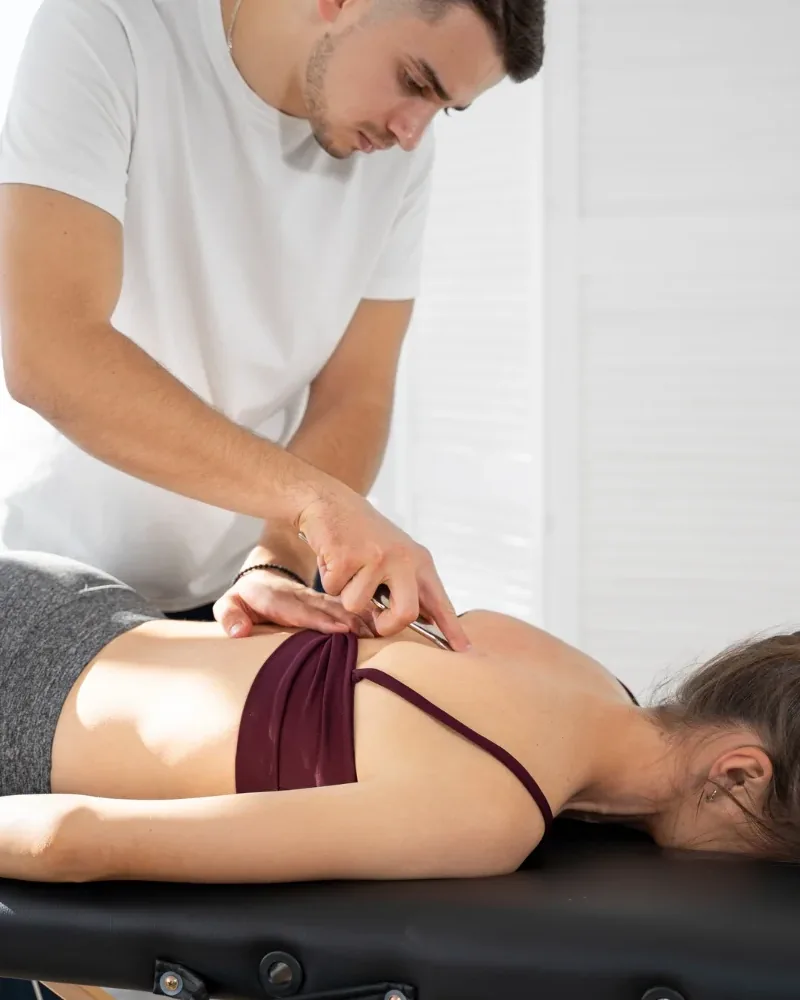
How physical therapy in Swansea helps.
Back pain is one of the most treatable problems we see, and the work starts with an evaluation rather than a guess. We measure range of motion, run nerve tension testing including a straight leg raise when leg symptoms are present, watch your posture and your gait, and read any imaging report you already have. Because your hips, spine, and ribs trade movement with each other, we use the Selective Functional Movement Assessment to find which link in that chain gave up its share, which is frequently somewhere other than where you feel pain.
From there the plan gets specific. Manual therapy restores glide in stiff facet joints and quiets guarding muscle, dry needling releases trigger points that will not let go on their own, and nerve gliding takes tension off an irritated sciatic nerve. Then we load you on purpose: progressive core, glute, and hip strengthening, plus lifting and sitting mechanics you can use at work the same day. Every session runs 40 minutes, one on one with a licensed physical therapist, in Swansea or at our Providence office, and two of our clinicians are board-certified orthopaedic clinical specialists.
What to expect from your recovery.
Evaluation
Your first visit is a hands-on assessment: range of motion, nerve tension testing, a straight leg raise if symptoms run down the leg, and a look at how you stand and walk. We also screen for the findings that belong with a physician rather than with us, and we tell you if we see them. You leave knowing what is driving your symptoms and what the plan does about it.
Settling the nerve and the guarding
Most patients come 2 to 3 times a week at this stage. Hands-on release, dry needling where it fits, and nerve gliding bring the irritation down far enough to move without bracing, and cold therapy plus frequent movement between visits protects that progress.
Building load tolerance
As symptoms settle we shift to strength: the deep core, the glutes, the hips, and the way you bend, lift, and carry. This is the phase that decides whether the pain stays away when your week gets heavy again. You get an honest estimate of how long that takes at the evaluation, and we tell you plainly when you no longer need us.
I had back surgery on 3/4 disc with excruciating pain on my sciatic nerve right side.
Pain rarely travels alone.

Nerve Pain
Tingling, burning, electric shocks down a limb. We find where the nerve is being crowded.

Hip & Knee Pain
Stairs, walking, stiffness that disrupts sleep. We restore the mechanics before we load them.

Chronic Pain
Pain that outlasted the injury. We change how the system responds, not just the tissue.
Ready when you are.
Fri: 7:00am - 3:40pm