Selective Functional Movement Assessment in Swansea, MA
You have already rested it, stretched it, and had somebody look at the spot that hurts. If it keeps coming back, that usually means the source is somewhere else in how you move.

What is the Selective Functional Movement Assessment?
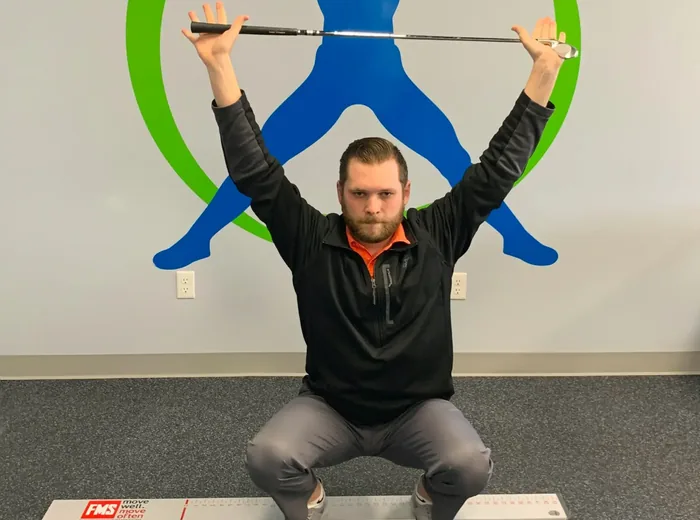
The SFMA is the clinical evaluation we start with when something already hurts. Instead of testing only the painful joint, your therapist takes you through seven top tier movement patterns: bending forward, reaching overhead, rotating, squatting, stepping, and moving your neck. Each pattern gets two verdicts, and only two. Does it move the way it should, and does it hurt. Any pattern that comes back limited or painful is then broken down piece by piece, loaded and then unloaded, active and then passive, until we know which of two very different problems you have. Either the tissue or joint will not go there, which is a mobility restriction, or you own the range but cannot control it under load, which is a motor control problem. Those two findings get treated in almost opposite ways, and that is the entire reason the breakdown is worth the time.
The structure exists because of regional interdependence: the region that hurts is often paying the bill for a restriction somewhere else. A stiff hip shows up as a sore low back. A locked ankle shows up as knee pain on stairs. Testing the whole chain is how we separate the source from the symptom, which is why so many people arrive here having had the painful area treated repeatedly with the same result. Dr. Greg Specht is an instructor for Functional Movement Systems and teaches the SFMA to other clinicians, so this is not a box we tick on an intake form. It is the backbone of how evaluations run at Swansea and at Providence. One note on which assessment you need: if you are not in pain and you want a movement screen for performance, that is Functional Movement Screening, and those results are what the Move 2 Perform algorithm turns into a risk category. The SFMA is the version built for people who hurt.
Who it's for.
If it hurts, if it has come back more than once, or if it never fully cleared after an injury, your problem has a movement story behind it. These three situations are the ones an SFMA answers best.
Pain nobody has explained yet
You have a label, or you have imaging that came back unremarkable, and neither one tells you why the pain arrives when it does. Testing the full chain of movement gives you a mechanical explanation instead of a shrug, and something specific to work on.
Cleared after surgery, still guarding
Your body built compensations while it was protecting itself, then kept them long after the tissue healed. We find which patterns you are still quietly avoiding and rebuild them in order, rather than loading strength on top of a pattern you are dodging.
The same problem, for the third time
Same shoulder, same hamstring, same side of your back, every few months. Recurrence usually means past treatment landed on the painful area and not on the restriction feeding it. This assessment looks at both, then treats the one driving it.
What to expect from your assessment.
This is a working evaluation, not a questionnaire. You will be moving, and you will get each finding explained as it happens. Your first visit runs longer than a standard forty minute appointment so there is room to test properly and still begin treatment.
History and the goal
We start with what happened, what makes it worse, and the specific thing you want back: sleeping on that side, lifting your kid, finishing a shift without bracing. That target decides what we test and how progress gets measured later.
The seven patterns
You move through the top tier patterns while your therapist records each one as functional or dysfunctional, painful or non painful. This is not a fitness test and there is nothing to pass. We want your honest movement, compensations included.
Breaking down what failed
Every pattern that came back limited or painful gets taken apart in a fixed order. Standing, then supported. Active, then passive. That sequence is what separates a stiff joint from a stability and motor control problem.
The plan, in plain language
You leave knowing what we found, what we believe is driving it, and what each corrective exercise is for. Most people start at two to three visits a week, and we retest the same patterns so improvement is measured rather than assumed.
Wear clothes you can bend, reach, and squat in. Come ready to tell us which specific movements provoke your symptoms, because the pattern that reproduces your pain is usually the most useful thing we learn all visit.
Zach Pereira is a skilled physical therapist without equal in the greater province area and perhaps New England and beyond. He is extremely knowledgeable and a great communicator.
Where to go next.
Functional Movement Screening (FMS)
Seven movement patterns, scored, to show which limitation is doing the damage.

Move 2 Perform
Your FMS and Y Balance results scored into a clear risk category, so the plan has a target.

Back Pain & Sciatica
The reason most people walk through our door. We find what is driving it, not just where it hurts.
Ready when you are.
Fri: 7:00am - 3:40pm