Tennis & Golf Elbow Treatment in Swansea
One small spot on the elbow ends up deciding everything: the club, the kettle, the laptop bag. Rest quiets it down, and the first hard grip brings it straight back.
What causes tennis & golf elbow?
Tennis elbow and golf elbow are the same problem in two places. Tennis elbow, or lateral epicondylitis, sits on the outside of the elbow where the muscles that lift the wrist attach. Golf elbow, or medial epicondylitis, sits on the inside where the muscles that flex the wrist and turn the palm attach. In both, repetitive wrist and forearm motion produces micro-tears in the tendon at that attachment, and the tendon becomes painful, thickened and slow to settle. You do not have to play either sport to get it: tradespeople, cooks and people who spend all day on a keyboard end up here as often as golfers do. If your symptoms are more about numbness, tingling or weakness spreading into the wrist and hand, start with our elbow, wrist and hand pain page instead.
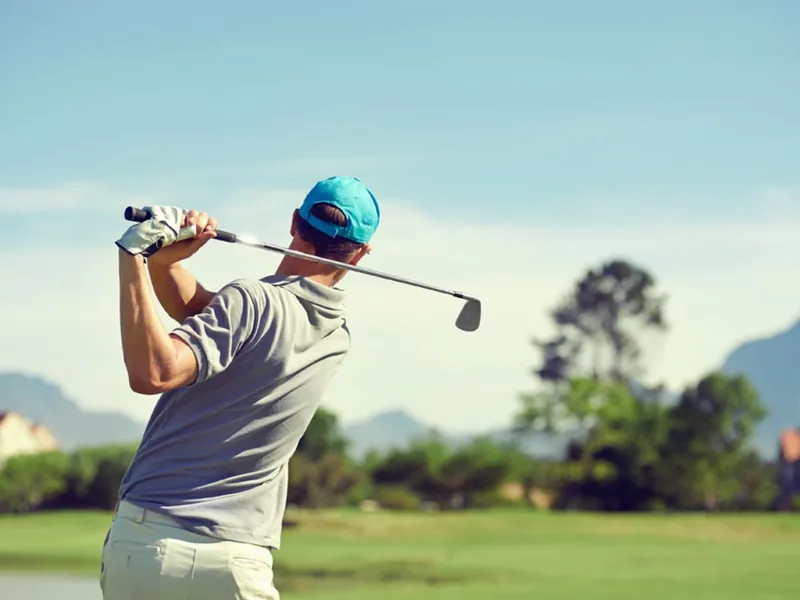
The tendon on the outside of the elbow anchors the muscles that cock the wrist back and hold it steady while you grip. Every single grip pulls on that one small attachment point, which is why a coffee cup can hurt as much as a backhand does. Sharp or burning pain on the outer elbow, reproduced by gripping or lifting with the palm down, is the classic presentation.
On the inside of the elbow, the tendon anchors the muscles that flex the wrist and rotate the forearm inward, which is the action through impact in a golf swing and in most pulling and twisting work. Overload there produces tenderness on the bony point of the inner elbow and pain with gripping, wringing or turning a screwdriver.
Neither version comes from one bad swing. They come from the same motion repeated at a rate the tendon cannot keep up with, so the micro-damage from each session accumulates instead of resolving. It is also why complete rest is not the answer: tendons need load to reorganize, just not the load that broke them.
A swing that flicks through the ball with the wrist, or a grip that is the wrong size for the hand, forces the forearm muscles to work harder for the same result. Small technique faults are cheap on any one swing and expensive across a season. We assess grip endurance and efficiency and look at how the wrist, elbow and shoulder sequence through the motion, because changing that sequence takes load off the tendon.
A tendon tends to fail at the point where the muscle behind it runs out. Forearm muscles that are strong for a few holes and finished by the back nine hand their work to the tendon, and the same is true for a tradesperson late in a shift. Building forearm endurance is what makes an elbow durable rather than merely comfortable today.
The elbow sits between two joints that both influence it. A stiff wrist or a shoulder that cannot rotate properly forces the elbow and forearm to make up the difference, and an inadequate warm-up sends you into the first hard efforts with tissue that is not ready. That is why we assess the whole arm rather than only the sore spot.

How physical therapy in Swansea helps.
Tendon pain has a well-established answer, and most of it comes down to loading the tendon correctly instead of avoiding it. The centerpiece is eccentric loading: slow, controlled lengthening work through the wrist and forearm that gives the tendon a reason to remodel and rebuild its tolerance. Around that, Manual Therapy uses soft tissue and joint mobilization to reduce the muscle tension pulling on the attachment and to restore elbow and wrist movement. Myofascial Release deals with the broader forearm tightness that develops when you have been guarding the arm for months. When a band of forearm muscle stays stubbornly tight and tender, Dry Needling gives us direct access to it. Then we address the activity itself: how you grip, how the wrist behaves through the swing, and how the shoulder and forearm share the job. Sports Rehab covers the return-to-play end, along with the warm-up and conditioning that keep forearm endurance where it needs to be. All of it is one-on-one, 40 minutes a session, at our Swansea and Providence offices, with two board-certified orthopaedic clinical specialists on staff.
What to expect from your recovery.
A four-part evaluation
We work through movement analysis of how the wrist, elbow and shoulder function together, strength testing to find the weaknesses feeding the strain, a grip assessment that measures endurance rather than just peak force, and a biomechanical screen of your swing or your work motion. Tendon problems are usually straightforward to identify and much less straightforward to load correctly, so the detail matters. You will know which side of the elbow is involved and what is driving it.
Load the tendon, calm the forearm
Hands-on work reduces the tension and stiffness around the elbow so the loading work is tolerable, and then the eccentric program does the heavy lifting. Tendons change slowly, and the honest version is that this stage takes patience: progress is measured in what your grip can tolerate, not in how the elbow feels on any single day.
Back to the swing, and staying there
Once the tendon tolerates real load, we rebuild forearm endurance and put the motion back together, working on grip and on how the wrist and shoulder sequence through your swing or your work. Return happens in stages, with warm-up and conditioning built in from the start. Periodic strength and technique check-ins are how most people keep it from coming back.
I was referred to Specht PT by my primary care doctor for tennis elbow. When I began treatment, I had almost no strength in my right arm and was in pain constantly.
Pain rarely travels alone.
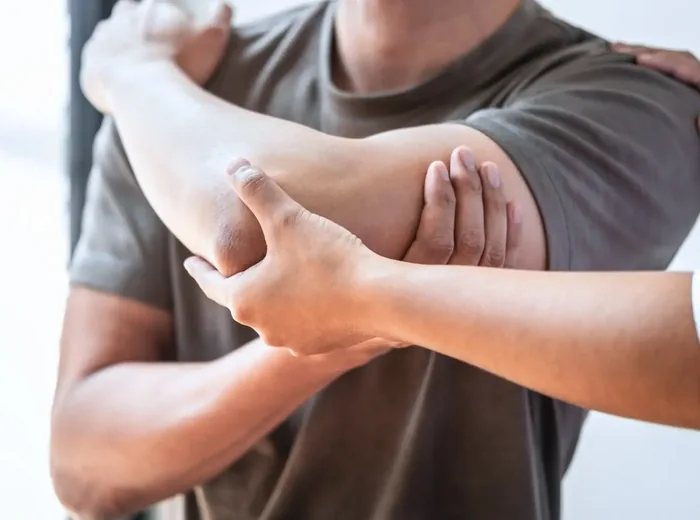
Elbow, Wrist & Hand Pain
Grip that fails, numbness in the fingers. We follow the problem up the whole chain.

Shoulder Pain
Reaching, sleeping, lifting overhead. Mobility first, then strength that holds.
Sports Injuries
Return-to-play built around your sport, your position and your actual timeline.
Ready when you are.
Fri: 7:00am - 3:40pm