Vestibular Therapy in Swansea, MA
Rolling over in bed sets the room spinning. Or the spinning stopped weeks ago and you still feel half a second behind your own head. Both respond to trained work rather than waiting.

What is vestibular therapy?
Vestibular therapy is progressive exercise for the balance system, prescribed like a dose. Your inner ear, your eyes and the position sense in your joints all report to the same place, and when one of them sends bad information the result is spinning, floating or unsteadiness. Treatment does one of three things depending on what the testing shows. Canalith repositioning is a specific sequence of head and body positions that moves displaced crystals out of the inner ear canal where they are setting off the spinning. Gaze stabilization trains your eyes to hold a target while your head moves, which is the reflex that falls short when an inner ear is underperforming. Habituation exposes you to the movement that makes you dizzy, in small controlled amounts, until your system stops overreacting to it.
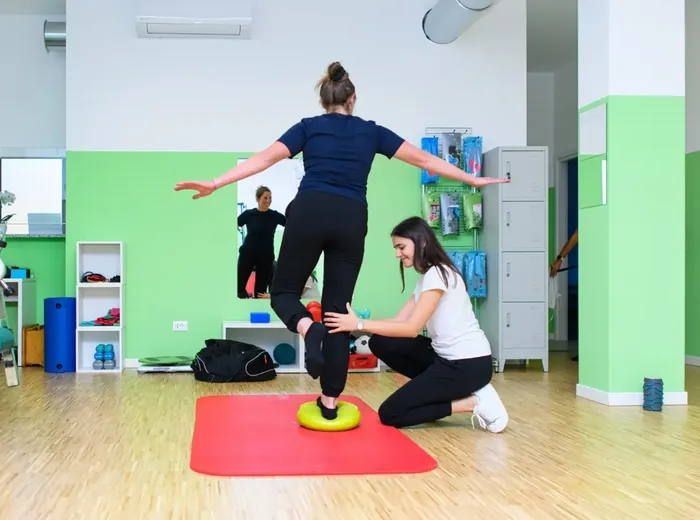
The skill is entirely in the dose. Too little and nothing adapts. Too much and you spend the rest of the day on the couch, which teaches you to avoid movement altogether. Your therapist picks an intensity that provokes a symptom you can recover from within minutes, then raises it as you tolerate more. Sessions run 40 minutes, one on one, in Swansea or Providence, and include balance and gait work on different surfaces, head turns while walking, and rehearsal of the real situations you have been avoiding, like a grocery aisle or a flight of stairs. Board-certified orthopaedic clinical specialists are on staff here, and whoever you see retests and adjusts your dose at every single visit.
Who it's for.
Dizziness is not one problem, and the treatment changes completely depending on which system is misreporting. These three presentations account for most of our vestibular caseload.
Spinning that starts when you change position
Lying down, rolling over or tipping your head back sets the room moving for under a minute, then it settles until the next time. That specific pattern responds to canalith repositioning performed in the clinic. The outcome we work toward: the positional spinning stopping, often after a small number of visits.
Steady after a concussion, but not right
The headaches eased and the vertigo passed, and yet busy rooms, screens and quick head turns still leave you off balance and drained by mid afternoon. Gaze stabilization and graded habituation retrain the systems that stayed sensitive. The outcome we work toward: tolerating motion and visual clutter again.
Unsteady, and starting to avoid things
You reach for walls, you stopped walking the dog after dark, and a near fall shook your confidence more than it hurt your body. Balance and gait training across varied surfaces rebuilds the control and the willingness together. The outcome we work toward: taking back the errands and the stairs you had quietly given up.
What to expect in a session.
A vestibular session looks nothing like a typical rehab visit. You spend most of it being carefully and deliberately provoked.
Testing what actually makes you dizzy
Your therapist takes a detailed history, including exactly what you were doing when it starts and how long it lasts, then moves your head and body through specific positions while watching your eyes and your reaction. That is what identifies which system is misreporting. You will feel symptoms during this, briefly and on purpose, with support the whole time.
Treatment matched to the finding
If it is positional, you get a repositioning sequence in that same visit. If an inner ear is underperforming, you start gaze stabilization. If motion sensitivity is the issue, habituation begins at a level you can recover from quickly. Balance and gait work on varied surfaces runs alongside whichever of those applies.
Home dosing and progression
Most of the adaptation happens between visits, so your home program is the treatment rather than homework. You get a small number of exercises with an exact frequency and clear instructions on what a normal reaction looks like. Each visit we retest, then raise the difficulty only as far as your response allows.
Bring someone to drive you to your first appointment if your dizziness is currently unpredictable, and eat something light beforehand. Dizziness has many possible causes, so your therapist screens your history at the evaluation and will refer you back to your physician or to an ear, nose and throat specialist when the picture points somewhere other than physical therapy. Feeling symptoms during a session is expected and is part of how the treatment works. Feeling worse for the rest of the day is not, and we lower the dose when that happens.
You could not find a better physical therapy office than Specht. They take the time to figure out what you want to achieve, what’s stopping you from achieving it and how you can make progress towards your goals.
Where to go next.

Dizziness & Vertigo
The room spinning when you turn or lie down. Often treatable in a handful of visits.
Balance & Gait Disorders
Unsteadiness, near-falls, a walking pattern that changed. Retrain it before it costs you.

Concussion
Headaches, light sensitivity, fog that will not clear. A graded return, not just rest.
Ready when you are.
Fri: 7:00am - 3:40pm