Neck Pain Treatment
You have swapped pillows, stretched at your desk, and rolled it out with a ball, and it is still there when you turn your head to back out of the driveway. Neck pain that keeps returning is a mechanics problem, not a willpower problem.
What causes neck pain?
Your cervical spine holds up the weight of your head all day, protects the spinal cord, and still lets you turn, tilt, and look up. It does that with small joints and small muscles, which leaves very little margin. When posture, tension, or one stiff segment changes how that load gets shared, your neck tells you, and sometimes your head, your shoulder blade, and your arm join in.

Every bit your head drifts forward of your shoulders multiplies the work the muscles behind your neck do to hold it up. Hours at a monitor, a phone, or a steering wheel keep those muscles in a low-grade contraction they never get to release, while the deep neck flexors that should be sharing the job go quiet. That is the ache at the base of the skull that arrives by mid-afternoon.
A repeated overhead reach, a night at a bad angle, or a jolt like a rear-end collision can strain the cervical muscles and the tissue around them. The tissue protects itself by tightening, which limits rotation and makes the injury feel bigger than it is. Restoring gentle motion early, rather than resting the neck completely, is what gets the range back.
The facet joints of the cervical spine wear over the years, and the segments next to a stiff one work harder to make up the missing movement. You feel it as a hard stop when you try to look over your shoulder, sometimes with a grinding quality. What shows on a scan matters less than how well those joints glide and how strong the muscles around them are.
When a cervical disc bulges or a segment narrows, the nerve root leaving your neck can be compressed. That is the point where symptoms stop being local: pain, pins and needles, or weakness travel into the shoulder blade, the arm, or the hand. A neurological screen tells us which level is involved, and unloading that nerve root is a different plan from treating a tight muscle.
Stress does not stay in your head. It shows up as a sustained pull through the trapezius and the muscles along the side of your neck, held for hours before you notice it. Muscle kept under tension that long becomes tender and starts referring pain up into the skull, which is why so many tension headaches actually begin in the neck.
A full night in a position that holds your neck out of neutral is a long treatment session pointed the wrong way. Stomach sleeping keeps the neck rotated for hours, and a pillow that is too tall or too flat does something similar. Sleeping on your back with support that keeps your neck in line with your spine removes a load before we treat anything.
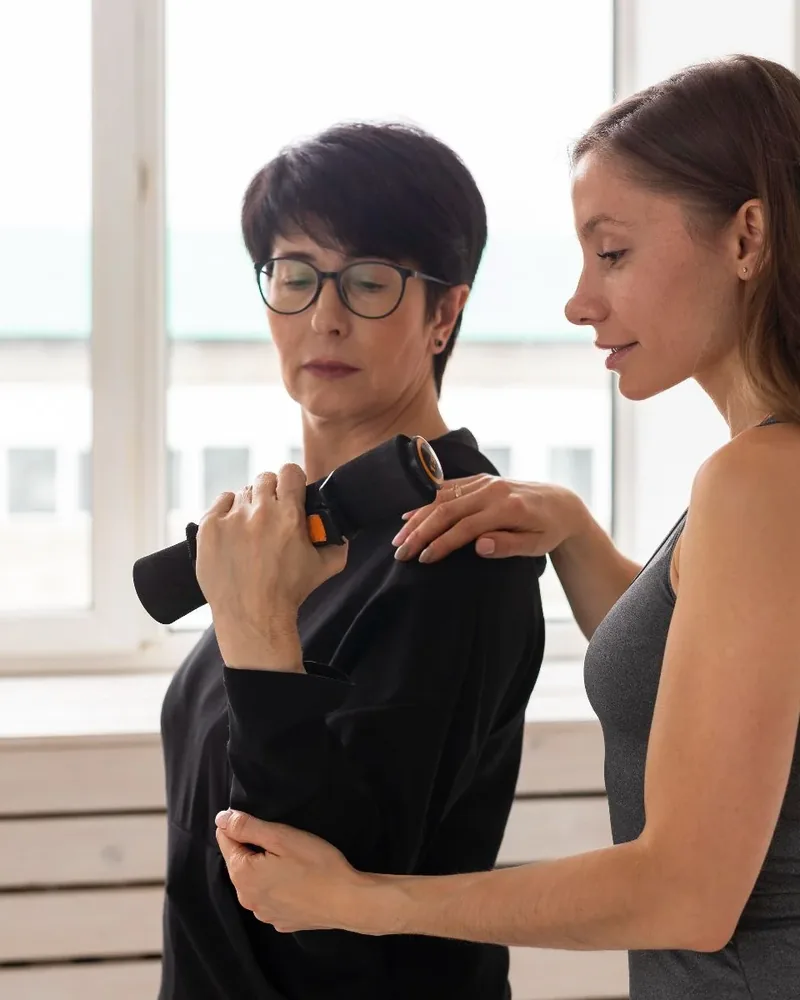
How physical therapy helps.
The evaluation separates what the neck is doing from what the neck is only reporting. We measure rotation, side bending, and extension, palpate segment by segment to find the level that has stopped gliding, run a neurological screen if symptoms travel into your arm, look at your working posture, and test how long your neck muscles hold before they fatigue.
Then the treatment follows the finding rather than a protocol. Manual therapy restores motion at the stiff segments, myofascial release takes sustained tension out of the trapezius and the tissue along the side of the neck, and dry needling is available for the trigger points that keep referring pain up into your head. Once you can move, we retrain: chin tucks and deep neck flexor endurance, strength through the shoulder blades, and a workstation, phone, and sleep setup that stops rebuilding the problem between visits. Sessions run 40 minutes, one on one with a licensed physical therapist, in Swansea or at our Providence office, and 95% of visits are with the same therapist, so nobody has to relearn your neck.
What to expect from your recovery.
Evaluation
Motion in every direction, hands-on assessment segment by segment, a neurological screen when symptoms travel into the arm, and a look at posture and muscle endurance. If your pain radiates into the arm with numbness or weakness, or it has not improved at all, that changes the plan and we say so on day one.
Getting the motion back
Hands-on work and soft tissue release open the segments and muscles that are limiting you, and headaches driven by neck tension often ease in the same stretch of care. Most patients come 2 to 3 times a week early on, with gentle range work and an ice pack at home holding the gains between visits.
Retraining and endurance
Motion you cannot control tends to disappear again. We build endurance in the deep neck flexors and the muscles that hold your shoulder blades down and back, then rehearse it in the positions you actually live in: your desk, your car, your pillow.
My experience at Specht Physical Therapy was wonderful. After working with Amelia for a few weeks, I was able to get back to the activities I had been missing.
Pain rarely travels alone.

Shoulder Pain
Reaching, sleeping, lifting overhead. Mobility first, then strength that holds.

Nerve Pain
Tingling, burning, electric shocks down a limb. We find where the nerve is being crowded.

Concussion
Headaches, light sensitivity, fog that will not clear. A graded return, not just rest.
Ready when you are.
Fri: 7:00am - 3:40pm