Rotator Cuff Tears Treatment in Swansea
It wakes you when you roll onto that side, and the arm has started feeling unreliable lifting things it used to handle without a thought. A cuff tear is not a verdict, but it does need a plan built around what actually tore.
What causes rotator cuff tears?
Cuff tendons give way in two very different ways, and the difference shapes your whole recovery. One is sudden: a fall, a heavy lift, an arm caught and yanked, healthy tendon overloaded in a single moment. The other is slow: tendon that has been compressed and worked without enough recovery for years, fraying until part of it finally lets go. Which story is yours tells us how the plan should start and how much of the tendon is likely still working.
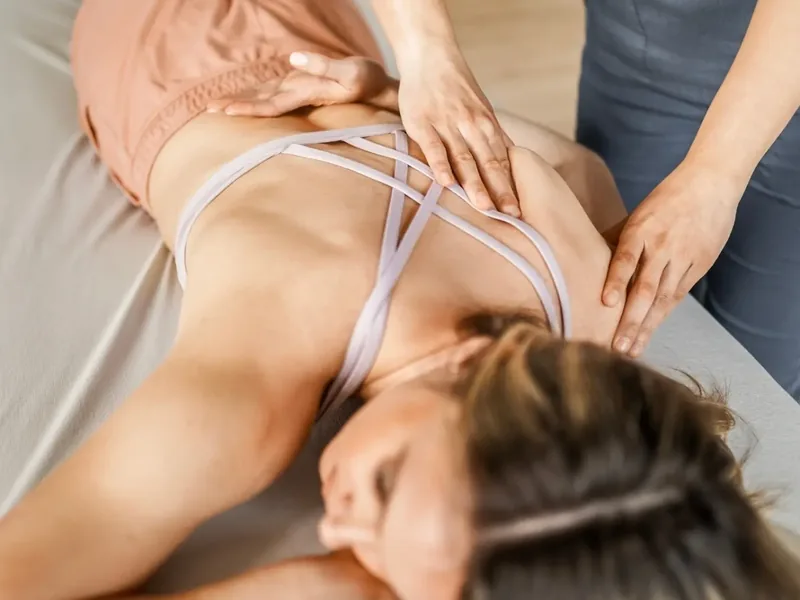
Catching yourself on an outstretched arm, hauling something heavier than you planned, or a fall onto the shoulder can tear tendon in one event. People with this kind of tear can usually name the day and the movement. Weakness tends to show up immediately, and lifting the arm out to the side or holding it there is the task that gives it away.
Degenerative change in tendon is quieter than an injury. The tissue gradually loses its tolerance for load, and a small area frays and thins long before anything dramatic happens, which is why some tears are found on a scan in a shoulder that barely aches. When the pain does arrive, there is usually no incident to point to, just a shoulder that has been getting less reliable for months.
The cuff tendon passes through a narrow space beneath the bony roof of the shoulder. When the ball of the joint rides slightly high, every overhead reach compresses that tendon against bone, and after enough repetitions the tissue is thinner than it was. Impingement is often the precursor to a degenerative tear, which is why treating it seriously matters even when nothing has torn yet.
Painting, framing, stocking shelves, swimming, and throwing all ask the cuff for the same effort over and over. Tendon adapts to load, but only if it gets recovery between bouts, and volume that climbs faster than the tissue can keep up with is what breaks that arrangement. The load itself is not the enemy. The rate it was added is.
Your shoulder blade has to rotate and tip out of the way as your arm goes up so the tendon has somewhere to go. If the muscles that control it are weak, or the cuff cannot hold the ball centred, the tendon takes the contact instead. This is the mechanical problem that survives a repair if nobody addresses it, and it is a large part of what rehabilitation is actually for.
A rounded upper back and a forward shoulder position physically reduce the room the tendon has to pass through. Hold that position for most of a working day and the tendon spends the day being pinched. Changing what your spine and shoulder blade do at rest gives the tendon back some of its clearance before we load anything.

How physical therapy in Swansea helps.
Here is the honest version: physical therapy does not knit torn tendon back together. What it does is rebuild the strength, glide, and mechanics of everything around the tear so the shoulder can do its work again, and that is why many people with partial tears get their function back without an operation. Testing tells us how much of the cuff is still contributing. We check joint stability and strength, analyse range of motion and flexibility, and assess posture and movement to find what put that tendon under load in the first place.
Conservative care starts with manual therapy and soft tissue work to settle irritation and give the joint back its motion, then moves into isolated cuff strengthening and shoulder blade control, then into progressive resistance the tendon can tolerate. If your tear does need surgical repair, therapy matters on both sides of it. Pre-surgical work hands your surgeon a shoulder with more motion and more strength to repair, and post-operative rehabilitation follows your surgeon's protocol: protected motion first, active motion when it is allowed, strengthening only when the repair can take it. That road is measured in months, not weeks, and you will hear that from us at the evaluation rather than halfway through. For overhead athletes and physical trades, sports rehab handles the return to throwing, swimming, or working above your head. Sessions run 40 minutes, one on one with a licensed physical therapist, in Swansea or at our Providence office.
What to expect from your recovery.
Evaluation and straight answers
Strength and stability testing, range of motion and flexibility analysis, and a movement assessment that shows how your shoulder blade and posture are loading the tendon. We tell you what the testing suggests, whether conservative care is a reasonable first road, and when an orthopaedic opinion belongs in the conversation. Nothing about that conversation is designed to keep you in treatment.
Calm it, then load it
Early visits reduce irritation and restore the motion the shoulder has been guarding, using hands-on work and gentle range. Then the cuff gets loaded deliberately, starting below the level that flares you and climbing as the tendon proves it can handle more. Most patients come 2 to 3 times a week through this phase.
Back to real load
The last phase looks like your actual life: reaching into a cabinet, carrying groceries up stairs, working overhead, sleeping through the night. If you have had a repair, this stage moves at the pace your surgeon's protocol sets. You finish with a home program and the self-care that keeps the shoulder holding its ground after you are discharged.
I had a wonderful experience at Specht Physical Therapy. After a fall, I ended up with chronic back pain and limited mobility. I was treated for a few months by Amelia Griffin.
Pain rarely travels alone.

Shoulder Pain
Reaching, sleeping, lifting overhead. Mobility first, then strength that holds.
Sports Injuries
Return-to-play built around your sport, your position and your actual timeline.
Neck Pain
Stiffness, radiating pain and the headaches that come with it. We treat the neck and what is pulling on it.
Ready when you are.
Fri: 7:00am - 3:40pm