Foot & Ankle Pain Treatment
The first steps out of bed are the worst part of your day, and by evening you are shortening your stride without thinking about it. Feet are the one thing you cannot put down, which is how this kind of pain settles in and stays.
What causes foot and ankle pain?
Your feet and ankles take every step you make, and they rarely fail all at once. Pain here builds out of small things that add up: an old sprain that never got rehabilitated, a calf that has quietly tightened, an arch that collapses a little further than it should, new shoes, a new job on your feet, or a jump in mileage the tissue was not ready for. Because everything in the foot changes how force travels up the leg, the place that hurts is often not the place that changed.

Running, jumping or a sudden increase in time on your feet loads tendons and ligaments faster than they can adapt, and the result is irritation and pain. Footwear is part of the same equation: an unsupportive shoe lets the foot collapse, a tight one crowds the forefoot, and a new pair changes the load overnight. The tissue can handle a great deal, but it needs the increase to arrive gradually.
The plantar fascia is the thick band running along the sole from heel to toes. When it is held under constant tension by tight calves, weak arch control and repeated loading, it becomes irritated where it attaches at the heel. The signature is sharp heel or arch pain with the first steps in the morning, easing as you warm up and returning after you sit for a while.
The Achilles takes the force of every push-off, so it is exposed both to training load and to a tight calf pulling on it all day. Worked repeatedly without enough recovery, the tendon becomes painful and stiff, usually at the back of the heel or just above it. Like other tendons it does better with specific graded loading than with rest alone.
A twist or a misstep tears the ligaments that stabilize the ankle, and a sprain that was iced and then forgotten leaves the joint less stable than it was. Years later that turns up as an ankle that swells easily, feels unreliable on uneven ground, or rolls again without much provocation. What is missing is usually strength and the position sense the joint lost, and both of those can be trained back.
High arches that will not flex and low arches that flatten too far both change how shock is absorbed and how far the foot rolls inward with each step. That altered mechanics pushes stress onto tissue that was not designed to take it, which is how pain appears in the arch, the heel or the outside edge of the foot. Improving arch control and ankle mobility changes the load pattern rather than only quieting the symptom.
Years of weight-bearing activity can wear down cartilage in the joints of the foot and ankle, form bone spurs and leave the joint stiff and sore. Old fractures and surgeries add scar tissue and restriction of their own. The wear in the joint is not reversible, but the strength and mobility around it are, and that is usually what decides how much it limits you.

How physical therapy helps.
Feet respond well to treatment, and they respond best when the plan matches the mechanism. We start by watching you walk and testing the parts: ankle mobility, calf length, arch control, single-leg balance and how the hip and knee behave above the foot. Manual Therapy then releases the tight calf and plantar tissue and restores movement to a stiff ankle or midfoot. The Y Balance Test gives us a measured picture of single-leg control and how the painful side compares with the other one, so progress becomes a number instead of an impression. From there it is loading: calf and foot strengthening, balance and position-sense work, and a graded return to whatever hurt. If running is the activity, Running Coaching addresses cadence, footwear choice and the way you load each step, which is usually where the trouble started. This happens in Swansea and in Providence, one therapist, 40 minutes a session, and most people come 2 to 3 times a week to begin with.
What to expect from your recovery.
Evaluation, including what needs a doctor first
The first visit maps how your foot and ankle move, where the pain comes from and what is loading it: gait, ankle range, calf flexibility, arch control and balance. It is also where we flag what needs a doctor before therapy: severe swelling, significant bruising or sharp pain immediately after an injury can mean a fracture or a torn ligament, and sudden ankle pain with no swelling and no injury can come from something medical such as gout.
Restore the movement
Hands-on work and targeted mobility give back what the foot and ankle have lost, usually calf length, ankle bend and midfoot movement. As those return, the tissue that has been compensating stops being overloaded, and pain with walking generally starts dropping before strength has caught up. Each session builds on the measurements from the last one.
Build strength, then load it up
Then we strengthen the foot, calf and hip, retrain balance so the ankle reacts to uneven ground on its own, and progress you back through standing, walking, hills, stairs and running in that order. Strength is what holds the improvement in place once you stop coming in. You leave with a program and a plan for what to do if a busy week starts to aggravate it again.
I went to Specht Physical Therapy for the treatment of plantar fasciitis. Greg took the time to explain the course of treatment at each of my visits, which made me feel very comfortable with his decisions.
Pain rarely travels alone.
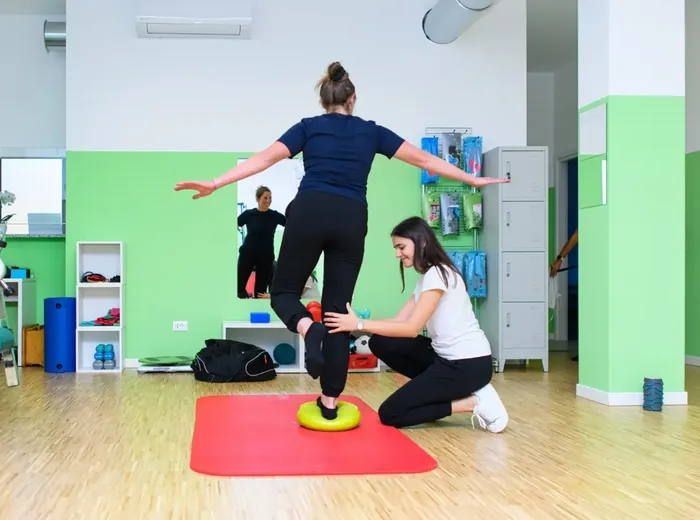
Balance & Gait Disorders
Unsteadiness, near-falls, a walking pattern that changed. Retrain it before it costs you.

Sports Injuries
Return-to-play built around your sport, your position and your actual timeline.

Hip & Knee Pain
Stairs, walking, stiffness that disrupts sleep. We restore the mechanics before we load them.
Ready when you are.
Fri: 7:00am - 3:40pm